
#6887. [2018 KAIST RUN Fall] Histogram Sequence

[2018 KAIST RUN Fall] Histogram Sequence
[2018 KAIST RUN Fall] Histogram Sequence
题目描述
A histogram is a polygon made by aligning $N$ adjacent rectangles that share a common base line. Each rectangle is called a $\textit{bar}$. The $i$-th bar from the left has width 1 and height $H_i$.:::align{center}
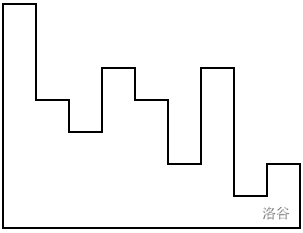
Figure: This picture depicts a case when and . :::
One day, you wanted to find the area of the largest rectangle contained in the given histogram. What you did was to make a list of integers by the following procedure:
- For each , calculate the largest area of the rectangle contained in the histogram, where the rectangle's base line coincides with the base line of the -th bar. Add the area to the list .
:::align{center}
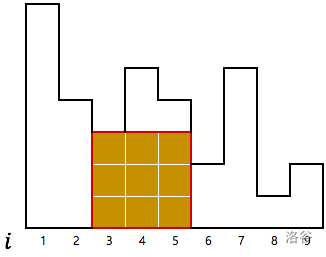
Figure: This picture depicts a case when and . The area is 9. :::
The length of the list is exactly since you chose each pair exactly once. To make your life easier, you sorted the list in non-decreasing order. Now, to find the largest area of the rectangle contained in the histogram, you just need to read the last element of , .
However, you are not satisfied with this at all, so I decided to let you compute some part of the list . You have to write a program that, given two indices and (), calculate the values , i.e. .
输入格式
The first line of the input contains an integer $N$ ($1 \le N \le 300\,000$) which is the number of bars in the histogram.The next line contains space-separated positive integers (), where is the height of the -th bar.
The last line contains two integers and (, ).
输出格式
Print $R - L + 1$ integers. The $j$-th ($1 \le j \le R-L+1$) of them should be the $(L+j-1)$-th element of the list $A$, i.e. $A_{L+j-1}$.9
7 4 3 5 4 2 5 1 2
42 4512 12 14 15