
#6165. [VKOSHP 2024] Intermediate Verticality

[VKOSHP 2024] Intermediate Verticality
[VKOSHP 2024] Intermediate Verticality
题目描述
Two classical graph algorithms --- depth-first search and breadth-first search --- construct two spanning trees in a graph. The depth-first search is known for producing a tree that has no $\textit{horizontal}$ edges, which are edges connecting vertices that are not ancestors of each other, while breadth-first search is known for producing a tree that has no $\textit{vertical}$ edges --- edges connecting a vertex to its ancestor in the tree. In this problem, you will need to construct an intermediate spanning tree that has a specified number of horizontal and vertical edges.Recall that an undirected graph consists of a set of vertices and a set of edges , where each edge connects two vertices. We will consider connected graphs, where it is possible to reach any vertex from any other vertex via edges. A tree is a connected undirected graph that contains no cycles, and a spanning tree in a graph is a subset of its edges that forms a tree, allowing one to reach any vertex of the graph from any other. Recall two fundamental properties of a tree: in a tree with vertices, there are exactly edges, and there is exactly one path between any two vertices in a tree.
We will designate a vertex in the graph, which we will call the of the tree. The vertices that lie on the unique path from vertex to vertex are called the of vertex , and the first vertex on this path is called the of vertex and is denoted as . The root has no parent.
If a root and a spanning tree are fixed in the graph, then all edges of the graph can be divided into three types:
- --- the edges of the chosen spanning tree;
- --- the edges not belonging to the tree that connect a vertex to its ancestor;
- --- the remaining edges of the graph.
:::align{center}
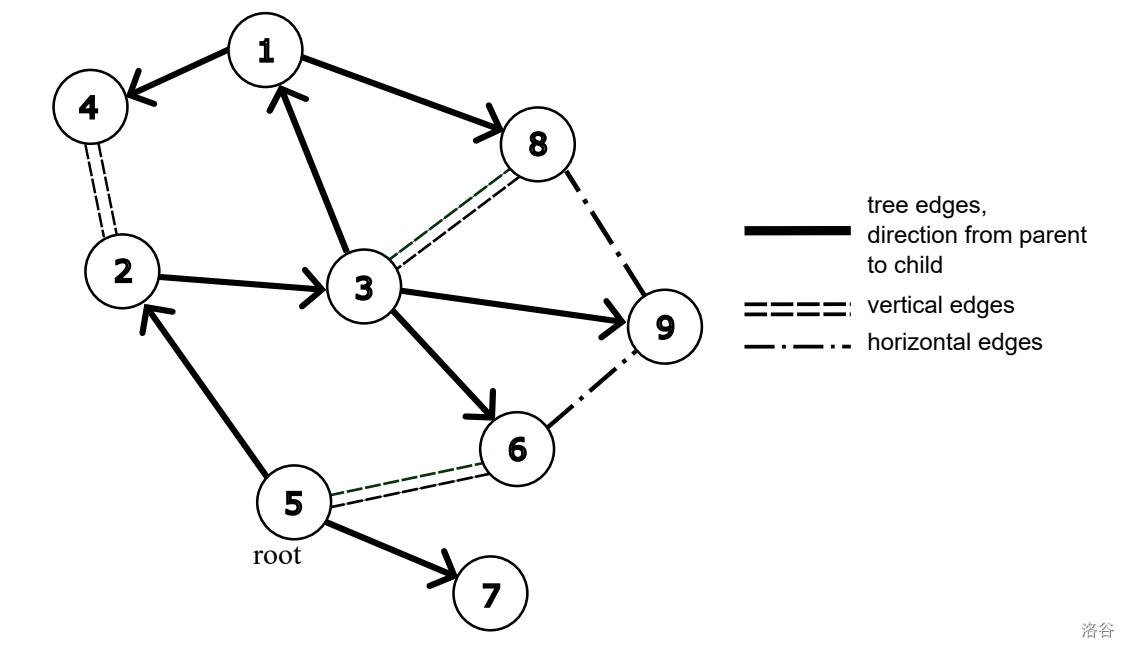 :::
The of the spanning tree in the graph is defined as the number of vertical edges.
You are given a graph with vertices and edges, the root of the tree , and a number , . You need to construct a spanning tree of the given graph with root at , having a verticality equal to , or report that such a tree does not exist.
输入格式
Each test consists of several sets of input data. The first line contains one integer $t$ --- the number of sets of input data ($1 \le t \le 10^5$). Following this are descriptions of $t$ sets of input data.In the first line of each set of input data, there are four integers , , , and --- the number of vertices and edges in the graph, respectively, the index of the root vertex, and the required verticality of the future spanning tree (; ; ; ).
In each of the following lines, there are two integers , --- the indices of the vertices connected by an edge in the graph (; ).
It is guaranteed that all graphs are connected, contain no loops or multiple edges. It is guaranteed that the sum of across all input data sets does not exceed . It is guaranteed that the sum of across all input data sets does not exceed .
输出格式
For each test case, find the required spanning tree $T$ and output in a separate line $n$ integers $p_1, p_2, \ldots, p_n$, where $p_i$ is the index of the parent of the $i$-th vertex in the tree $T$ ($1 \le p_i \le n$). For $p_r$, you can output any number from $1$ to $n$. If a tree $T$ with the desired properties does not exist, output $n$ numbers $-1$ instead.4
5 7 2 0
1 2
2 3
3 4
4 1
3 5
5 4
1 5
5 7 2 1
1 2
2 3
3 4
4 1
3 5
5 4
1 5
5 7 2 2
1 2
2 3
3 4
4 1
3 5
5 4
1 5
5 7 2 3
1 2
2 3
3 4
4 1
3 5
5 4
1 52 1 2 3 3
2 1 4 1 1
2 1 5 5 1
2 1 4 1 3