

[IOI 2025] World Map
[IOI 2025] World Map
题目描述
Mr. Pacha, a Bolivian archeologist, discovered an ancient document near Tiwanaku that describes the world during the Tiwanaku Period (300-1000 CE). At that time, there were $N$ countries, numbered from 1 to $N$.In the document, there is a list of different pairs of adjacent countries:
$$\begin{aligned}(A[0], B[0]), (A[1], B[1]), \ldots, (A[M - 1], B[M - 1]).\end{aligned}$$For each (), the document states that country was adjacent to country and vice versa. Pairs of countries not listed were not adjacent.
Mr. Pacha wants to create a map of the world such that all adjacencies between countries are exactly as they were during the Tiwanaku Period. For this purpose, he first chooses a positive integer . Then, he draws the map as a grid of square cells, with rows numbered from 0 to (top to bottom) and columns numbered from 0 to (left to right).
He wants to color each cell of the map using one of colors. The colors are numbered from 1 to , and country () is represented by color . The coloring must satisfy all of the following conditions:
- For each (), there is at least one cell with color .
- For each pair of adjacent countries , there is at least one pair of adjacent cells such that one of them is colored and the other is colored . Two cells are adjacent if they share a side.
- For each pair of adjacent cells with different colors, the countries represented by these two colors were adjacent during the Tiwanaku Period.
For example, if , and the pairs of adjacent countries are and , then the pair was not adjacent, and the following map of dimension satisfies all the conditions.
:::align{center}
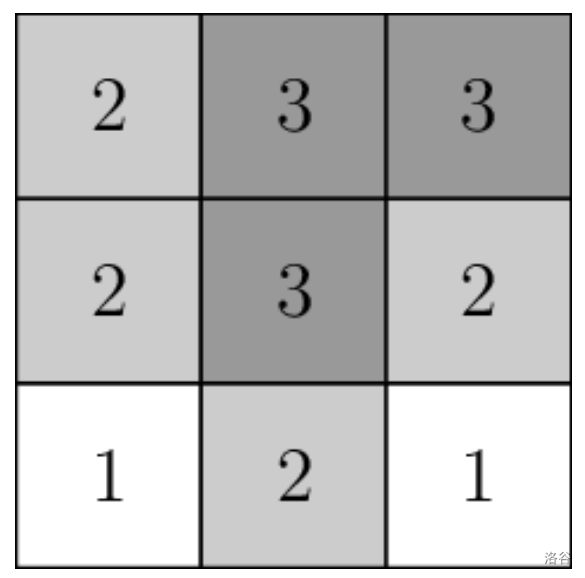 :::
In particular, a country does not need to form a connected region on the map. In the map above, country 3 forms a connected region, while countries 1 and 2 form disconnected regions.
Your task is to help Mr. Pacha choose a value of and create a map. The document guarantees that such a map exists. Since Mr. Pacha prefers smaller maps, in the last subtask your score depends on the value of , and lower values of may result in a better score. However, finding the minimum possible value of is not required.
Implementation Details
You should implement the following procedure:
std::vector<std::vector<int>> create_map(int N, int M, std::vector<int> A, std::vector<i
- : the number of countries.
- : the number of pairs of adjacent countries.
- and : arrays of length describing adjacent countries.
- This procedure is called up to times for each test case.
The procedure should return an array that represents the map. Let be the length of .
- Each element of must be an array of length , containing integers between and inclusive.
- is the color of the cell at row and column (for each and such that ).
- must be less than or equal to .
输入格式
The first line of the input should contain a single integer $T$, the number of scenarios. A description of $T$ scenarios should follow, each in the format specified below.N M
A[0] B[0]
:
A[M-1] B[M-1]
输出格式
``` P Q[0] Q[1] ... Q[P-1]C[0][0] ... C[0][Q[0]-1] : C[P-1][0] ... C[P-1][Q[P-1]-1]
Here, $P$ is the length of the array $C$ returned by create_map, and $Q[i]$ ($0 \leq i < P$) is the length of $C[i]$. Note that line 3 in the output format is intentionally left blank.

<pre><code class="language-input1">2
3 2
1 2
2 3
4 4
1 2
1 3
2 4
3 4</code></pre>
<pre><code class="language-output1">3
3 3 3
2 3 3
2 3 2
1 2 1
7
7 7 7 7 7 7 7
2 1 3 3 4 3 4
2 1 3 3 3 3 3
2 1 1 1 3 4 4
2 2 2 1 3 4 3
1 1 1 2 4 4 4
2 2 1 2 2 4 3
2 2 1 2 2 4 4</code></pre>

<h2>提示</h2>
### Example 1

Consider the following call:
create_map(3, 2, [1, 2], [2, 3])
This is the example from the task description, so the procedure can return the following map.
[ [2, 3, 3], [2, 3, 2], [1, 2, 1] ]
### Example 2

Consider the following call:
create_map(4, 4, [1, 1, 2, 3], [2, 3, 4, 4])
In this example, $N = 4$, $M = 4$ and the country pairs $(1, 2)$, $(1, 3)$, $(2, 4)$, and $(3, 4)$ are adjacent. Consequently, the pairs $(1, 4)$ and $(2, 3)$ are not adjacent.

The procedure can return the following map of dimension $K = 7$, which satisfies all the conditions.
[ [2, 1, 3, 3, 4, 3, 4], [2, 1, 3, 3, 3, 3, 3], [2, 1, 1, 1, 3, 4, 4], [2, 2, 2, 1, 3, 4, 3], [1, 1, 1, 2, 4, 4, 4], [2, 2, 1, 2, 2, 4, 3], [2, 2, 1, 2, 2, 4, 4] ]
The map could be smaller; for example, the procedure can return the following map of dimension $K = 2$.
[ [3, 1], [4, 2] ]
Note that both maps satisfy $K / N \leq 2$.

### Constraints

* $1 \leq N \leq 40$
* $0 \leq M \leq \frac{N \cdot (N-1)}{2}$
* $1 \leq A[i] < B[i] \leq N$ for each $i$ such that $0 \leq i < M$.
* The pairs $(A[0], B[0]), \ldots, (A[M-1], B[M-1])$ are distinct.
* There exists at least one map which satisfies all the conditions.

### Subtasks and Scoring

| Subtask | Score | Additional Constraints |
| :-: | :-: | :-: |
| 1 | 5 | $M = N - 1$, $A[i] = i + 1$, $B[i] = i + 2$ for each $0 \leq i < M$. |
| 2 | 10 | $M = N - 1$ |
| 3 | 7 | $M = \frac{N \cdot (N - 1)}{2}$ |
| 4 | 8 | Country 1 is adjacent to all other countries. Some other pairs of countries may also be adjacent. |
| 5 | 14 | $N \leq 15$ |
| 6 | 56 | No additional constraints. |

In subtask 6, your score depends on the value of $K$.

- If any map returned by create_map does not satisfy all the conditions, your score for the subtask will be $0$.
- Otherwise, let $R$ be the **maximum** value of $K/N$ over all calls to `create_map`. Then, you receive a **partial score** according to the following table:

| Limits | Score |
| :-: | :-: |
| $6 < R$ | $0$ |
| $4 < R \leq 6$ | $14$ |
| $3 < R \leq 4$ | $28$ |
| $2.5 < R \leq 3$ | $42$ |
| $2 < R \leq 2.5$ | $49$ |
| $R \leq 2$ | $56$ |
标签: P13537|2025|IOI|交互题|Special Judge
<h2>来源</h2>
P13537|[IOI 2025] World Map