
#5656. [OOI 2024] Draw Polygon Lines

[OOI 2024] Draw Polygon Lines
[OOI 2024] Draw Polygon Lines
题目描述
*This is an interactive problem.*You are given points on the plane. It is known that all are distinct and all are distinct.
Your task is to draw polygonal lines connecting these points.
A polygonal line is defined by a permutation of numbers from to . The polygonal line consists of segments, the first segment connects points and , the second segment connects points and , , the last segment connects points and . Note that segments may intersect.
The of a polygonal line is defined as the number of indices such that the angle is acute, i.e., strictly less than .
You need to solve four tasks:
- Find any polygonal line that has the maximum possible sharpness.
- Given an integer . Find any polygonal line whose sharpness is .
- Given an integer .
Answer queries, each specified by a single integer (). In the -th query, you need to construct a polygonal line that has sharpness exactly . - Given an integer .
For each from to , construct a polygonal line with sharpness exactly . Provide numbers $\text{hash}\left(p^{(c)}\right), \text{hash}\left(p^{(c+1)}\right), \ldots, \text{hash}\left(p^{(n-c)}\right)$ as the answer, where $hash(p) = \left( \sum\limits_{i=1}^{n} p_i b^{i-1} \right) \bmod m$ is the polynomial hash of permutation with parameters and .
Then answer queries, each specified by a single integer (). In the -th query, you need to provide the polygonal line . It will be checked that the sharpness of this polygonal line is exactly and its hash matches the previously provided value .
Note that queries will appear after receiving the hashes.
It is guaranteed, that under given constraints, the answers always exist.
Interaction Protocol
The first line contains two integers , (, ) --- the number of the task to be solved in this test and the test group number.
The second line contains a single integer () --- the number of points on the plane.
Each of the next lines contains two integers , () --- the coordinates of the points. It is guaranteed that all are distinct and all are distinct.
If , then the input ends here and you should output any permutation with the maximum possible sharpness. The interaction ends here.
If , then the next line contains a single integer ().
If , then the input ends here and you should output any permutation with sharpness . The interaction ends here.
If , your solution should output integers $\text{hash}\left(p^{(c)}\right), \text{hash}\left(p^{(c+1)}\right), \ldots, \text{hash}\left(p^{(n-c)}\right)$, where . Note that this should not be done if .
Further interaction occurs only if or .
The next line contains a single integer () --- the number of queries.
Then times, in each line, a query () appears. As a response, you should output a permutation on a separate line. The sharpness of this permutation should be exactly . If , the hash of this permutation should match the previously provided hash.
Since this is an interactive problem, after outputting each line, do not forget to output a newline character and flush the output buffer.
输入格式
(暂无输入格式说明)输出格式
(暂无输出格式说明)1 0
4
2 3
1 8
4 2
0 0
3 2 4 12 0
5
-2 0
-1 -1
0 1
2 -2
3 -3
2
5 4 3 1 23 0
6
0 0
1 1
2 2
3 -3
4 -2
5 -1
2
3
2
3
4
1 2 3 4 5 6

4 5 6 1 3 2

6 2 4 3 5 1
4 0
5
-2 -1
-1 1
1 6
0 -3
2 0
2
2
2
3
534735187 776162084


4 5 1 2 3

1 3 2 5 4
提示
### NoteIn all the figures, acute angles are denoted by two arcs, and non-acute angles are denoted by a single arc.
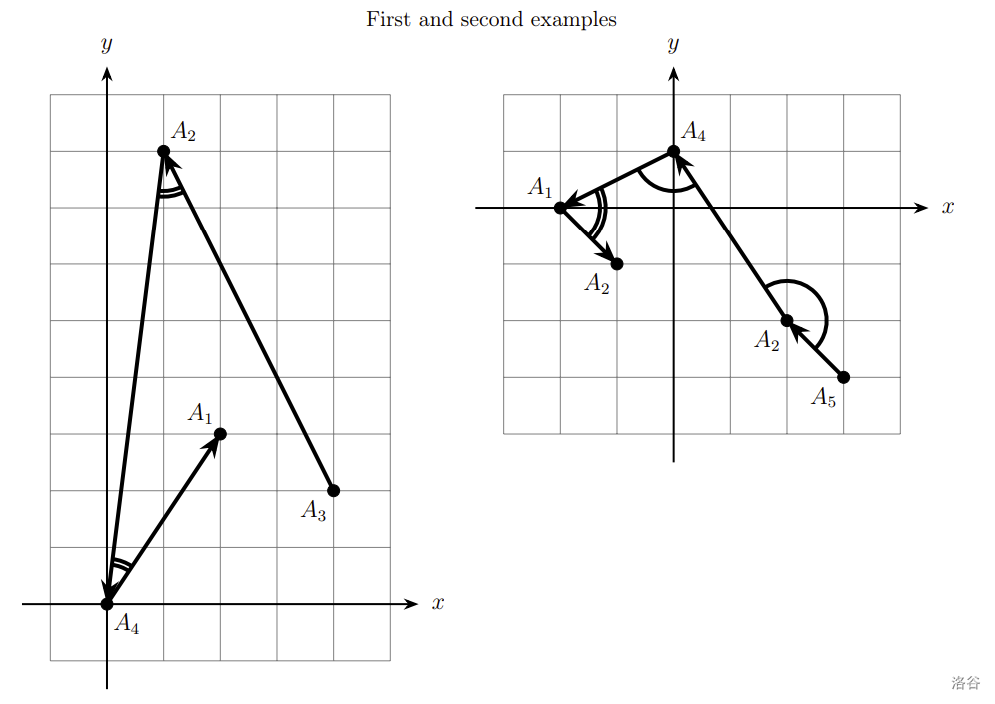
In the first example all angles are sharp, so the line has maximum sharpness .
In the second sample the sharpness equals to , it is .
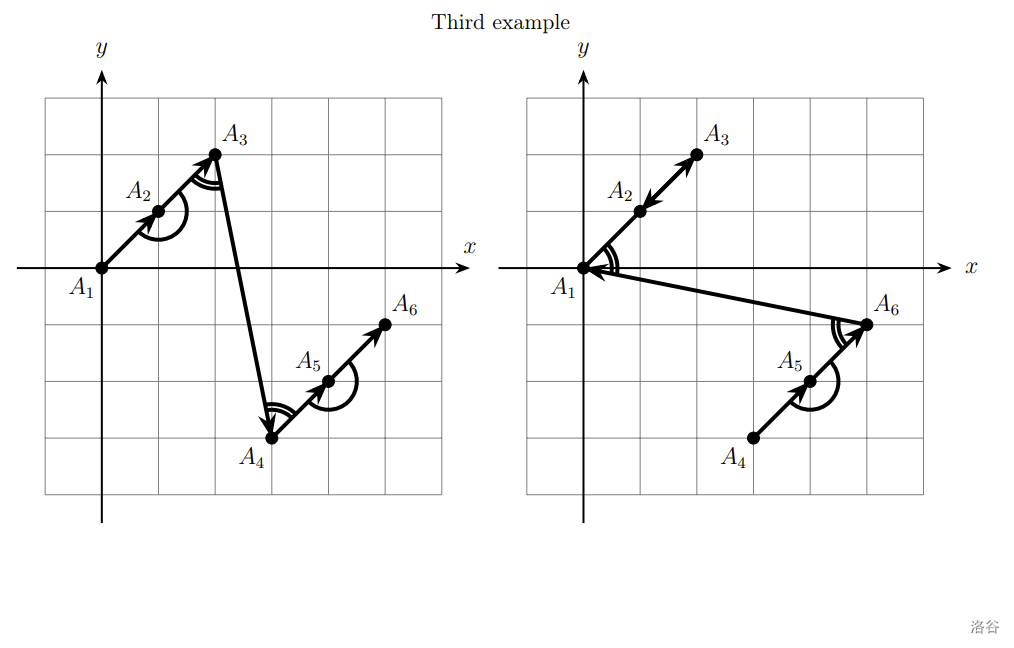
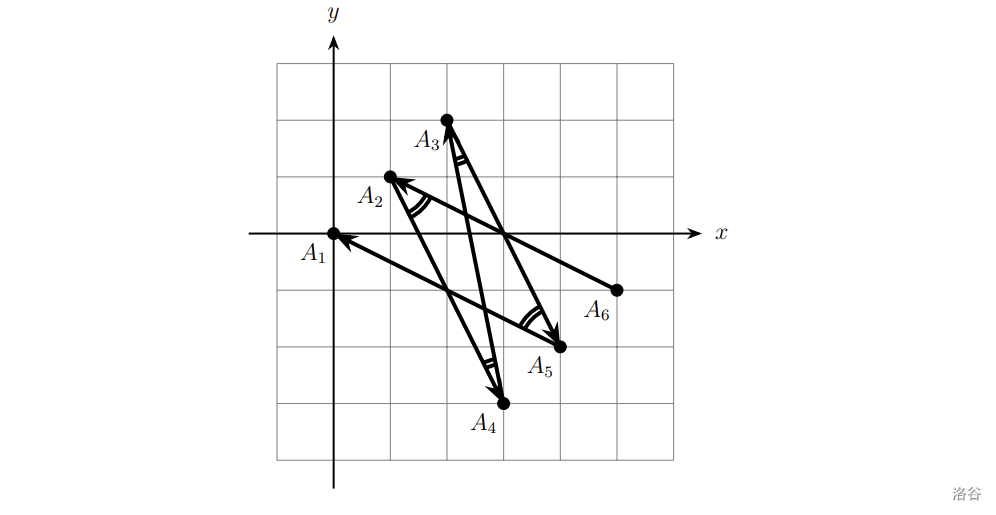
In the third example the lines have sharpness , , .
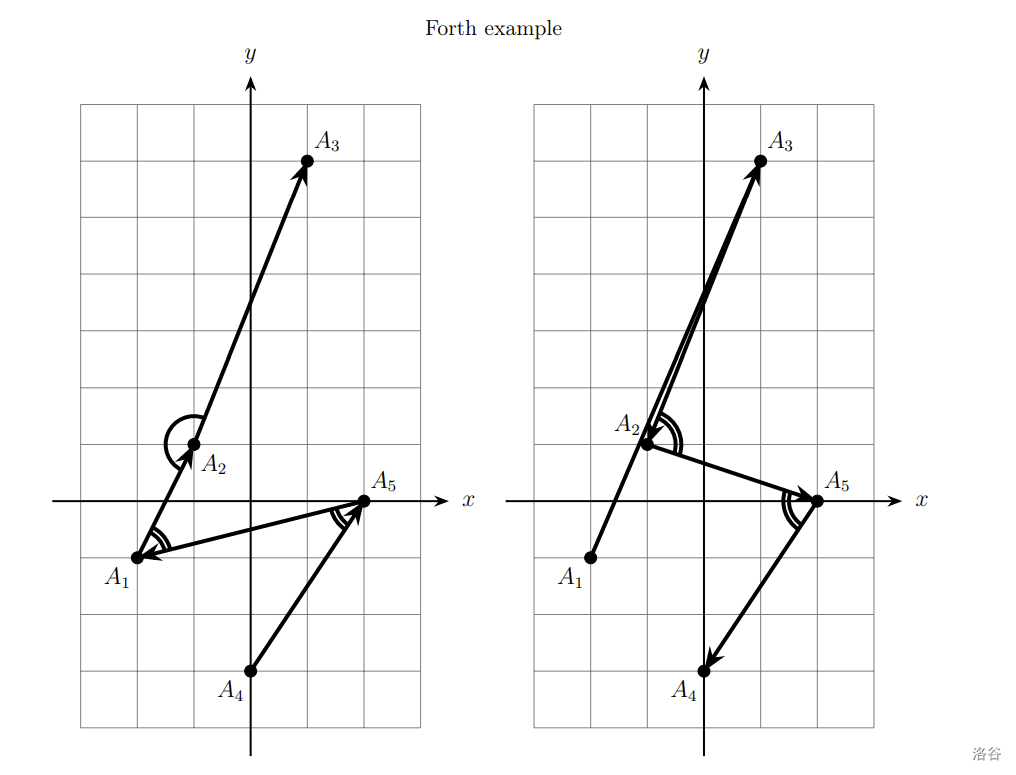
In the forth example we build lines that have sharpness and . The lines have hashes equal to the ones provided earlier.
Scoring
The tests for this problem consist of twenty-one groups. Points for each group are given only if all tests of the group and all tests of the required groups are passed.
| Group | Points | task | Additional constraints | Required Groups | Comment | ||
|---|---|---|---|---|---|---|---|
| 0 | - | - | - | - | Examples. | ||
| 1 | 8 | 1 | |||||
| 2 | 6 | random points | |||||
| 3 | 5 | 2 | |||||
| 4 | 2 - 3 | ||||||
| 5 | 6 | - | 1 - 4 | ||||
| 6 | 17 | 2 | - | ||||
| 7 | 3 | ||||||
| 8 | 4 | random points | |||||
| 9 | |||||||
| 10 | |||||||
| 11 | 3 | ||||||
| 12 | |||||||
| 13 | 12 | ||||||
| 14 | - | 12 - 13 | |||||
| 15 | 2 | 7, 12 - 14 | |||||
| 16 | 6 | 4 | - | ||||
| 17 | 3 | random points | |||||
| 18 | |||||||
| 19 | 18 | ||||||
| 20 | - | 18 - 19 | |||||
| 21 | 2 | 16, 18 - 20 | |||||
In the groups where it is indicated that the points are random, all coordinates of all points , are randomly generated with equal probability in the interval . 标签: P13502|2024|交互题|Special Judge|Moscow Olympiad