
#5541. [GCJ 2010 #1C] Making Chess Boards

[GCJ 2010 #1C] Making Chess Boards
[GCJ 2010 #1C] Making Chess Boards
题目描述
The chess board industry has fallen on hard times and needs your help. It is a little-known fact that chess boards are made from the bark of the extremely rare Croatian Chess Board tree, (Biggus Mobydiccus). The bark of that tree is stripped and unwrapped into a huge rectangular sheet of chess board material. The rectangle is a grid of black and white squares.Your task is to make as many large square chess boards as possible. A chess board is a piece of the bark that is a square, with sides parallel to the sides of the bark rectangle, with cells colored in the pattern of a chess board (no two cells of the same color can share an edge).
Each time you cut out a chess board, you must choose the largest possible chess board left in the sheet. If there are several such boards, pick the topmost one. If there is still a tie, pick the leftmost one. Continue cutting out chess boards until there is no bark left. You may need to go as far as cutting out 1-by-1 mini chess boards.
Here is an example showing the bark of a Chess Board tree and the first few chess boards that will be cut out of it.
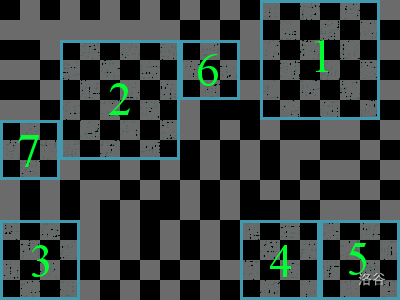
输入格式
The first line of the input gives the number of test cases, $T$. $T$ test cases follow. Each one starts with a line containing the dimensions of the bark grid, $M$ and $N$. $N$ will always be a multiple of $4$. The next $M$ lines will each contain an $(N/4)$-character hexadecimal integer, representing a row of the bark grid. The binary representation of these integers will give you a strings of $N$ bits, one for each row. Zeros represent black squares; ones represent white squares of the grid. The rows are given in the input from top to bottom. In each row, the most-significant bit of the hexadecimal integer corresponds to the leftmost cell in that row.输出格式
For each test case, output one line containing "Case #$x$: $K$", where $x$ is the case number (starting from $1$) and $K$ is the number of different chess board sizes that you can cut out by following the procedure described above. The next $K$ lines should contain two integers each -- the size of the chess board (from largest to smallest) and the number of chess boards of that size that you can cut out.4
15 20
55555
FFAAA
2AAD5
D552A
2AAD5
D542A
4AD4D
B52B2
52AAD
AD552
AA52D
AAAAA
5AA55
A55AA
5AA55
4 4
0
0
0
0
4 4
3
3
C
C
4 4
6
9
9
6Case #1: 5
6 2
4 3
3 7
2 15
1 57
Case #2: 1
1 16
Case #3: 2
2 1
1 12
Case #4: 1
2 4提示
**Sample Explanation**The first example test case represents the image above.
Limits
- ;
- will be divisible by 4;
- Each hexadecimal integer will contain exactly characters.
- Only the characters 0-9 and A-F will be used.
Small dataset (18 Pts, Test set 1 - Visible)
- ;
- .
Large dataset (24 Pts, Test set 2 - Hidden)
- ;
- ;
- The input file will be at most 200kB in size. 标签: P13398|动态规划 DP|2010|堆|Google Code Jam